
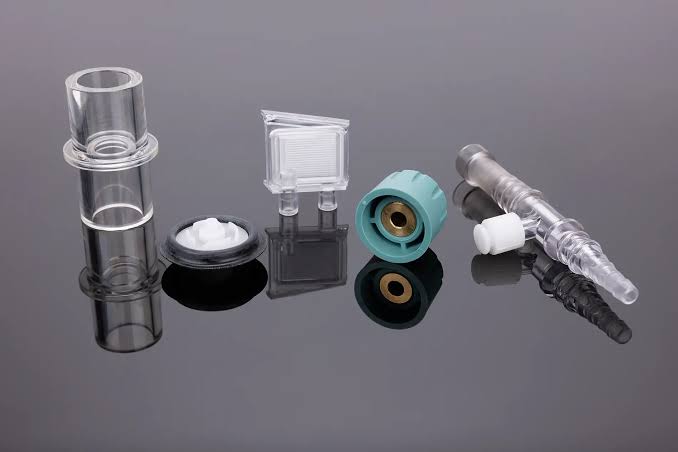
High precision plastic injection molding produces polymer components to dimensional tolerances and surface quality standards that standard injection molding cannot achieve. For medical device applications, where a component may serve as a valve seat, a lens carrier, a diagnostic test cartridge, or a drug delivery mechanism, dimensional deviations of tens of microns translate into device performance variation that affects clinical outcomes.
The distinction between standard and high precision plastic injection molding lies in the entire system around the moulding machine, not just the machine itself: the tooling precision, the material handling, the process control, and the inspection capability that together determine what dimensional consistency is achievable in production.
What Makes Plastic Injection Molding Precision
Standard injection moulding tolerances for most commercial applications are in the range of ?0.1 to ?0.3 millimetres for feature dimensions. High precision moulding achieves tolerances of ?0.02 to ?0.05 millimetres on critical dimensions, and in specific applications tighter still. This precision requires:
Precision tooling: moulds machined to the accuracy required by the part tolerances, with surface finishes appropriate for the component’s optical or functional requirements.
Controlled material handling: polymer resins are moisture-sensitive; inadequate drying before processing causes dimensional variation and surface defects. Precision moulding operations dry materials to specified moisture content before each production run.
Process control: injection speed, pressure, temperature, and hold time must be controlled within narrow windows and monitored continuously during production. Process capability analysis, using statistical process control, demonstrates that the process is producing within specification consistently.
Dimensional measurement: coordinate measuring machines, optical comparators, and laser scanning systems verify that the parts meet their dimensional specifications. Measurement capability must be adequate to distinguish good parts from marginal ones reliably.
Medical Device Polymer Materials
Medical device applications of high precision plastic injection molding use a range of engineering polymers selected for their combination of mechanical properties, biocompatibility, and compatibility with sterilisation processes:
Polycarbonate for transparent housings, lenses, and diagnostic cartridges where optical clarity is required.
Polypropylene and polyethylene for single-use components where chemical resistance and gamma sterilisation compatibility are important.
PEEK for high-performance structural components where strength, chemical resistance, and biocompatibility in demanding environments are all required.
Liquid crystal polymer (LCP) for components requiring very tight dimensional control and stability, including connector housings and precision alignment parts.
“Medical devices must work every time, for every patient,” said former Health Sciences Authority chief executive John Lim. High precision injection moulded components are how that reliability is built into the device from the manufacturing stage.
Clean Room Moulding for Medical Components
High precision moulding for medical device components is typically performed in a clean room environment. The clean room classification required depends on the component’s end use. Components that will be further sterilised after assembly can be produced in ISO Class 8. Components used in sterile paths or with direct patient contact may require ISO Class 7.
The clean room environment addresses contamination risks that are incompatible with medical device quality requirements: particles embedded in component surfaces can affect assembly fit or create sterility risks in the finished device.
AMT High Precision Plastic Injection Molding
AMT provides high precision plastic injection molding for medical and healthcare components in clean room environments, with quality systems certified to ISO 13485. Their process capabilities and dimensional inspection resources support the tight tolerances and complete traceability that medical device production requires.


